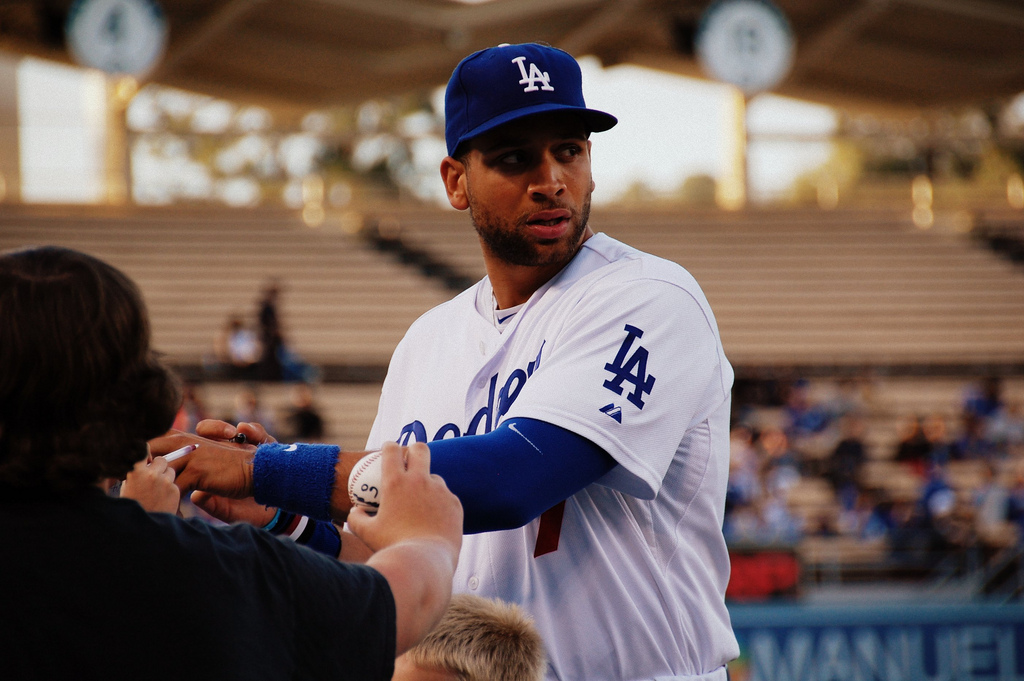
Showing posts with label Jerry Sands. Show all posts

Monday, October 29, 2012

2012 Los Angeles Dodgers Season Review: Outfield

The Dodgers had one of the best-looking outfields in the National League heading into the 2012 season. Despite not having a left fielder, the combination of Matt Kemp and Andre Ethier were tough to beat. After acquiring Carl Crawford, the outfield should be that much better in 2013 and beyond.

Dodger outfielders by the numbers

Left Field
.254/.325/.349
76 R, 34 2B, 4 3B, 6 HR, 52 RBI, 21 SB, 63 BB

Center Field
.275/.340/.449
98 R, 30 2B, 5 3B, 23 HR, 84 RBI, 21 SB, 58 BB

Right Field
.265/.328/.439
86 R, 38 2B, 1 3B, 23 HR, 97 RBI, 3 SB, 52 BB

Individual performers

Bobby Abreu
.246/.361/.344, 3 HR, 19 RBI, 28 R, 15.2 BB%
- Abreu was picked up off waivers in May and got off to a nice start as a Dodger. In his first 33 games, Abreu hit .326/.444/.461 while playing a lot of left field. His next 37 games, however, were forgettable: .178/.267/.222. His poor performance got him designated for assignment. After a brief minor-league stint, he was exclusively a pinch-hitter for the Dodgers in September. Considering what he is at this point in his career, Abreu gave the Dodgers more than people expected.
Grade: C-

Andre Ethier
.284/.351/.460, 20 HR, 89 RBI, 36 2B, 8.1 BB%
- Ethier's season was no surprise. He, as usual, was streaky and his overall numbers reflected that. He started his 2012 on a hot streak, as he hit .327/.384/.566 in his first 52 games. In his next 61 games, he hit .234/.315/.329. He finished the season strong at .304/.364/.522, including eight of his 20 home runs. A couple things to note: Ethier's walk and strikeout rates went in the wrong direction. His walk rate dropped nearly 2.5 percent and his strikeout rate increased nearly 1.5 percent. For a guy heading into his age-31 season, that isn't a good sign. However, his performance earned him a contract extension, which I liked at the time. But unless he figures out left-handed pitching (.222/.276/.330), he's going to be the most expensive platoon man this side of Alex Rodriguez.
Grade: B-

Tony Gwynn
.232/.276/.293, 4 3B, 17 RBI, 13 SB, 5.8 BB%
- Gwynn was signed to a 2-year deal in the winter, and I was a big fan of it. Gwynn also earned praise early in the season for his pinch-hitting. However, after he was asked to step in full-time for Kemp, his offensive ineptitude was exposed. From May 29 through Aug. 5 (his last game in the majors in 2012), he hit just .188/.235/.243. No matter how good his glove is in center field (and it is that good), a triple slash like that won't cut it. He was relegated to Albuquerque for the rest of the season. He's signed for 2013 at $1.15 million, so it'll be interesting to see what the Dodgers do with him.
Grade: D

Elian Herrera
.251/.340/.332, 10 2B, 17 RBI, 26 R, 10.8 BB%
- The man who seemed to come out of nowhere, Herrera, like a lot of other Dodgers, got off to a fast start. He made his Major League debut on May 15. Through June 12, he was hitting .300/.400/.378 while playing primarily second and third base for the team. Again, like a lot of other Dodgers, he struggled after his hot streak: .206/.280/.289. He'll be in the mix for the utility player spot for the team in 2013.
Grade: C-

Matt Kemp
.303/.367.538, 23 HR, 69 RBI, 22 2B, 8.9 BB%
- Kemp, coming off an MVP-caliber season in 2011, struggled with injury. The sad thing is, he got off to an incredible start. Before suffering his first hamstring injury in May, he was hitting .359/.446/.726. Kemp tried to come back too soon, aggravated the same injury and was out for a month. He came back and hit well before he cooled off a bit.  After running into the center field wall in Colorado, he struggled mightily. Kemp had a 20-game stretch where he was downright atrocious (.159/.216/.256). He finished the season strong, though (.367/.406/.867). He had shoulder surgery earlier this month and should be back for Spring Training. Let's just hope the injury doesn't sap his power.
Grade: B

Juan Rivera
.244/.286/.375, 9 HR, 47 RBI, 14 2B, 5.3 BB%
- Rivera was, as expected, pretty awful this season. In fact, he was worse this season for the Dodgers than he was in the 62 games he played for them in 2011. I mean, the man had a negative bWAR (-0.9) and fWAR (-0.8). He wasn't even replacement-level good, yet he played 109 games. That's usually a recipe for disaster. Rivera has a club option for 2013 which, if the Dodgers are smart, they'll decline it
Grade: D- (and that's being generous)

Shane Victorino
.245/.316/.351, 2 HR, 15 RBI, 15 SB, 7.7 BB%
- An ill-advised trade deadline acquisition, Victorino was pretty bad for the Dodgers -- especially since he cost the team Josh Lindblom, Ethan Martin and, to a lesser extent, Stefan Jarrin. Victorino had a career-year in 2011, but came crashing back to earth in 2012. Thank goodness the Dodgers traded for Crawford, or it'd be almost a sure thing Victorino would be back in Blue in 2013.
Grade: D-

The rest

Alex Castellanos, Grade: INC
Jerry Sands, Grade: INC
Scott Van Slyke, Grade: INC

Next up: Infielders

Photo credits: Dustin Nosler, Feelin' Kinda Blue

Thursday, September 13, 2012

My 2012 Los Angeles Dodgers' minor league Players of the Year

It was an interesting year in the Dodgers' farm system. The team made a bunch of trades that hurt the system's depth. In fact, they traded away the likely winner of this award, Leon Landry, in the Brandon League deal.

Hitter of the Year
OF Joc Pederson, Rancho Cucamonga
.313/.396/.516, 18 HR, 70 RBI, 96 R, 26 SB

- Pederson started off the season slowly, hitting just three home runs through the month of June. Then, he took off. The toolsy outfielder would go onto hit 15 home runs the rest of the season while helping to pace the Quakes' offense.

His OPS was .739 through June. He finished with a .913 OPS and, despite playing in the California League, is an impressive feat for a 20-year-old.

Pederson's best day came on July 1, when he smacked a franchise-tying three home runs against the High Desert Mavericks.

Pederson's 26 stolen bases were second-best in the system, but he was also caught 14 times. He'll need to improve that percentage going forward.

Despite the addition of Yasiel Puig, Pederson might be the team's best position prospect. He got a taste of Double-A last week in the Southern League Playoffs. He went 3-for-11 with a triple. He should start the season with the Chattanooga Lookouts next season as a 21-year-old.

Runners up: Jerry Sands, Alex Castellanos

Pitcher of the Year
RHP Matt Magill, Chattanooga Lookouts
11-8, 3.75 ERA, 1.28 WHIP, 2.91 FIP, 10.3 K/9

- Not often will a 3.75 ERA get much praise or acclaim, but Magill's season was quite impressive. Like Pederson, Magill was playing against slightly advanced competition and actually improved from his age-21 to age-22 season.

The most impressive stat was his 10.3 strikeouts per nine innings. Magill's stuff isn't overpowering by any means. His fastball has been described as fringy, but it must be good enough to amass a league-leading 168 strikeouts.

He also allowed significantly fewer baserunners this season. He reduced his hits per nine innings from 10.1 last season to 7.8 this season. His walks per nine innings was up by 0.4, but he cut his WHIP by nearly 0.21 (from 1.49 to 1.28).

Finally, in 146 1/3 innings this season, he gave up just eight home runs. That's outstanding.

The Dodgers tend to keep top pitching prospects away from Triple-A. While Magill doesn't have the upside top-of-the-rotation upside, he does profile as a back-end starter in the majors, provided his stuff translates to the bigs and he refines his command.

I could see him beginning next season in Double-A and wouldn't be overly shocked to see him in Albuquerque. He'll have to be added to the 40-man roster this winter, but that's a formality at this point.

Runners up: Zach Lee, Steve Ames

Wednesday, September 5, 2012

A brief look at the Dodgers' farm system following trading season

The Dodgers were as active as they've been in years on the trade market this year. They acquired some big-name talent (Josh Beckett, Adrian Gonzalez, Hanley Ramirez), but they also gave up quite a few young players.

Here's a scorecard of Dodger prospects and young players traded since July 25 (Ramirez trade):

Position players
Ivan De Jesus
Leon Landry
Jerry Sands (player to be named later)

Pitchers
Logan Bawcom
Rubby De La Rosa (PTBNL)
Nathan Eovaldi
Josh Lindblom
Ethan Martin
Scott McGough
Ryan O'Sullivan
Allen Webster

As you can see, the Dodgers certainly dealt from their strength. For the last few seasons, the Dodgers' biggest strength has been their young pitching. That's what the farm system was known for.

Of the three position players the Dodgers traded, two of them have every day potential. Sands, who curiously wasn't given a legitimate shot in Los Angeles, was sent to Boston in the August blockbuster. Landry, a player I'm higher on than most, just won the California League batting title (.341). He was traded with Bawcom to get Brandon League. He also led the league in triples (18) while finishing in second in total bases (262) and doubles (34).

The Dodgers traded eight young pitchers. Not many teams can do that and still have solid pitching depth. Don't get me wrong, it isn't as good as it was a couple months ago, but there are still some quality arms remaining. But the system, even more so now, lacks front-end starters.

Zach Lee and Chris Reed are the organization's top two pitching prospects by far -- and Lee is in a class my himself. Then there are starting pitching prospects like Garrett Gould, Matt Magill, Onelki Garcia and Andres Santiago. Definitely not the same potential star power as before with De La Rosa, Webster and Eovaldi paired with Lee and Reed.

The 2012 draft and International signings didn't really help strengthen the pitching side of things. Garcia was drafted in the third round and Zachary Bird, pegged as a sleeper by many, was a ninth-round pick. And we won't know much about a guy like Bryan Munoz, a 16-year-old, for a few years.

For the first time in a long time, it seems the Dodgers have more high-end (for this system, at least) hitting prospects than pitching prospects. Joc Pederson, Yasiel Puig and Corey Seager all have potential to be above-average everyday players.

So, Logan White has some work to do rebuild the pitching side of the system. Relief pitching is still strong (Shawn Tolleson, Steve Ames, Steven Rodriguez, Javier Solano), but the Dodgers will need some high-end starters down on the farm going forward.

Speaking of Andres Santiago...

This is my latest at Chad Moriyama's blog about the 22-year-old pitching prospect who's making a name for himself this season.
"There are a couple things that impress me most about Santiago. First, his increased strikeout rate. While he was able to get solid rates in the past (8.0, 7.4, 8.4 K/9 the last three seasons), he’s stepped up to another level this year. His 9.8 K/9 is second only to Matt Magill for best among starting pitchers in the system."
Looking forward to see how he handles a full season in Double-A.
Photo credits 
Reed: Courtesy of Brandon Lennox, True Blue LA
Landry: Dustin Nosler, Feelin' Kinda Blue

Sunday, August 26, 2012

Looking at who the Red Sox acquired in the big trade with the Dodgers

I've been accused of being a prospect hoarder. It's a fair accusation. But when I heard about this deal, my first thought was, "The Dodgers are giving up too much." I still believe that.

But at least the Dodgers acquired a hitter who paid immediate dividends in Adrian Gonzalez. He blasted a 3-run home run on his first swing as a Dodger Saturday night. It was a thing of beauty.

But considering the circumstances, the Red Sox made out quite well in Saturday's nine-player deal with the Dodgers. Boston acquired major salary relief (in the neighborhood of $260 million), James Loney, Rubby De La Rosa, Allen Webster, Jerry Sands and Ivan De Jesus.

I gave my thoughts on the Dodgers' return yesterday, so now I'll look at who the Dodgers gave up and what it means for the Red Sox.

James Loney

Loney, a once top prospect, is going to be fighting for a job come the winter. His offensive production is just offensive and not even his Gold Glove defense can land him a starting gig.

And Loney did what he does best in his first at-bat as a member of the Red Sox: he grounded into a double play.

He'll likely be Boston's starting first baseman the rest of the season, but I'd be shocked if he was there beyond this season.

Rubby De La Rosa

Because he was on the 40-man roster, De La Rosa is a player to be named later in this trade. He was reportedly claimed by the Blue Jays, which means the entire National League and a few American League teams passed on claiming him. That doesn't make sense, but I'm not a baseball executive.

De La Rosa was optioned to Double-A Chattanooga and I'm admittedly unsure what the plan is with him. I assume he'll pitch because for the Lookouts until the season ends. Chattanooga is three games up for the second-half division title with eight games to play. So, there's at least eight games remaining plus any potential playoff games.

Or, the Dodgers could be under strict orders from Boston to not pitch De La Rosa in game action and just continue to have him work on the side, potentially avoiding injury. We'll see what happens.

But Boston acquired a potential No. 2 starter in De La Rosa. His fastball, clocked as high as 101 MPH, is his best pitch. He throws it in the mid-90s with movement. It's a filthy pitch. He also owns a devastating changeup, when he's consistent with it.

The only thing holding De La Rosa back from achieving his potential in the rotation is a third pitch. He has a slider that's loose and loopy more than it's tight and sharp. His makeup is that of a top-of-the-rotation starter or a dominant closer, so no concern there.

He has a much better shot of ending up in the bullpen, but I could definitely see De La Rosa figuring it out and him being a pitcher in the mold of Pedro Martinez.

Now, some have said the Dodgers just traded "the next Pedro Martinez," but I think that's a bit far-fetched. Yes, they have similar repertoires and are both from the Dominican Republic. But that's where the similarities end.

De La Rosa isn't the most physically imposing figure, but he also isn't 5'10, 175 pounds like Martinez was. It's far more likely De La Rosa is an average MLB pitcher than a Hall of Famer.

Boston did quite well to get De La Rosa from the Dodgers in this deal, as they did with the only true "prospect" they received in the deal.

Allen Webster

Webster, the Dodgers' consensus No. 2 or No. 3 prospect heading into the season, started off the season about as poorly as one could. On May 9, he owned a 7.49 ERA in the Southern League, a league in which he struggled during the second half of last season.

Things weren't looking good for him until a demotion to the bullpen changed his season. He had a five-game bullpen stint, starting May 15, and he gave up just one run in that time. His work out of the 'pen allowed him to get his control and command figured out because his stuff has never been a question.

Since returning to the rotation on May 31, he hadn't allowed more than three earned runs in any start and reduced his ERA down to a manageable 3.83.

Webster boasts a low-to-mid-90s fastball with movement, an advanced changeup, a solid curveball and a decent slider. He has a classic starter's arsenal. Aside from his changeup, he's also known for having good control. His 3.7 BB/9 is solid, but he has the potential to be a sub-3 BB/9 guy when he's at his peak.

He has a ceiling of a No. 2 starter, but it's more likely he'll be a No. 3 or No. 4 guy, which is nothing to scoff at. Webster should challenge for a rotation slot in Boston come 2013.

Jerry Sands

Like De La Rosa, Sands is officially a PTBNL in this deal because he did not clear waivers. And that's just fine with Isotope fans as Sands smacked a 2-run home run Saturday night to continue his torrid second half.

Yes, his numbers are somewhat inflated because he plays in one of the best hitting environments in professional baseball, but there is potential in this kid. I mean, he had a 1.078 OPS in the Midwest League as a 22-year-old (69 games). That's hard to do.

I ranked him as my No. 1 prospect heading into last season and he's gotten limited opportunity with the Dodgers thus far. In fact, I'm not sure he was ever going to get a fair shot. I mean, when a team will play the likes of Juan Rivera and Loney instead of giving a 24-year-old power-hitting prospect a shot, it says something about the player or the organization. It's probably a little of both.

But Sands has ability. If he reaches his potential, he could be a 20-plus home run a season corner outfielder who hits in around .270 to .300 with an on-base percentage .350 or better. He isn't afraid to talk a walk, as his minor-league walk rate is an impressive 11.6 percent. He's done nothing but hit in the minors (.290/.377/.566), yet the Dodgers never gave him a legitimate chance at being a regular.

Sands profiles better as a corner outfielder than a first baseman. He has a strong arm and has a little more range than folks give him credit for. With the Red Sox trading their left fielder and first baseman, Sands could get a shot at either position come 2013.

Sands might be Boston's wild card in this deal, as the Dodgers clearly (and unfairly) lost faith in him too soon.

Ivan De Jesus

De Jesus is kind of in the same boat as Sands, but he got there first: a once highly rated prospect who fell out of favor in the organization.

Now, De Jesus is never going to be Dustin Pedroia at second base, but he has on-base ability and a solid glove.

He's more of a utility player at this point in his career, which has value to a team. He has a little doubles pop and a good eye at the plate, posting a 9.7 percent walk rate in the minors.

He hasn't done much in the majors, but he hasn't been given much of a chance either. We'll always have that pinch-hit double in Arizona earlier this season that won the game for the Dodgers.

Conclusion

The Dodgers still gave up a bit too much in this deal for my liking. If they had given up De La Rosa or Webster, along with the other two, and a lesser prospect, I'd feel a little better about this. I just don't like giving up two potential frontline starting pitchers while taking on more than a quarter of a billion dollars in salary. But at least the Dodgers got the big bat they needed.

I'll look at what impact this trade, and all the trades Ned Colletti and Co. have made in the last couple months, has on the Dodgers' farm system tomorrow.

Photo credits
Loney and Sands: LWY, Flickr
De Jesus:  wisely, Flickr

Saturday, August 25, 2012

Looking at the Dodgers' return in the potential trade with the Red Sox

With the blockbuster Dodger-Red Sox trade expected to be announced today, I'm going to look at just what the Dodgers are getting themselves into with this deal.

The Dodgers and Red Sox are about to complete one of the biggest deals in baseball history, but the Dodgers are the team taking almost all the risk.

Here are the details:

To Boston: Rubby De La Rosa (as PTBNL), Allen Webster, James Loney, Jerry Sands and Ivan DeJesus
To Los Angeles: Adrian Gonzalez, Josh Beckett, Carl Crawford, Nick Punto and roughly $12 million

Adrian Gonzalez

The Dodgers finally get a legitimate slugger to slot in behind Matt Kemp. Gonzalez, 30, is one of the best first basemen in baseball, but he's admittedly having a down season -- down being .300/.343/.469. The Dodgers haven't received that production from first base since the days of Eric Karros... or when Loney was just a young pup in 2007, when he played in 96 games.

Gonzalez, like Loney, plays Gold Glove-caliber defense at first base, so there will be virtually no drop-off there. Coupled with the enormous offensive boost, this is a no-brainer.

Gonzalez, a former No. 1 overall pick by the Florida Marlins (2000), is somewhat local. He's from the San Diego area and spent the vast majority of his professional career with the Padres.

But something that is greatly needed is the fact he can hit against left-handed pitching. This season, he owns a .302/.335/.488 triple slash. His average and slugging percentage are better against lefties than righties this season. He hit .321 against lefties last season, a season in which he led the American League in hits while hitting 27 home runs and 45 doubles. In 2010, he hit a whopping .337/.424/.513 against lefties. It shows marked improvement as his career numbers against lefties are not as good (.276/.345/.443), meaning he struggled earlier in his career against southpaws.

But the best part about acquiring Gonzalez is the fact he has elite-level talent (and he has the contract to prove it). He's a top-five first baseman (Albert Pujols, Prince Fielder, Joey Votto, Paul Konerko) and one of the best with the glove.

Gonzalez signed a 7-year, $154 million deal with Boston in April 2011. Here's the breakdown:
  • 2013 through 2016: $21 million annually
  • 2017 and 2018: $21.5 million annually
Pretty straight forward.

Now, some of Gonzalez's numbers have been trending downward, such as his walk rate and isolated power.

Year BB% ISO
2009 17.5 .274
2010 13.4 .231
2011 10.3 .210
2012 5.9 .169

Gonzalez was walked like crazy in the Padres' lineup, as he was about the only hitter to fear during his time. That accounts for the 17.5 percent walk rate. But his rate dropping all the way to 5.9 this season is a bit concerning. He's never walked fewer than 52 times in a full season, which he did in 2006.

He started off the 2012 season poorly, hitting just .283/.329/.416 in the first half. But he's really turned it on in the second half: .338/.378/.593. It's nice to see the power is still there, but I'd also love to see that walk rate get back in the neighborhood of 10 percent. With Ramirez and Andre Ethier hitting behind him, I could see that happening.

It's always a good idea to take a risk on elite talent. Gonzalez is elite. The other two Red Sox coming over, well, aren't in that class anymore.

Josh Beckett

Many remember Beckett for his 2003 World Series performance -- an MVP performance -- but Beckett has never been that good over the long haul.

However, Beckett, 32, is coming off one of the better seasons of his career in 2011, a season in which he went 13-7 with a 2.89 ERA, 1.03 WHIP, 3.57 FIP, 6.8 H/9, 2.4 BB/9, 8.2 K/9 and a 3.37 K/BB.

This season, Beckett has struggled: 5-11, 5.23 ERA, 4.27 FIP. He hasn't endeared himself to the Boston media after golfing on his day off after missing a start earlier this season -- something that was blown out of proportion by the Boston media, but is worth noting.

His contract status pales in comparison to Gonzalez's and Crawford's, but here are the details anyway: 
  • 2013-14: $15.75M
That's it. His contract is the least of the Dodgers' concern in this deal.

If Beckett can regain his 2011 form, this could be huge for the Dodgers. Chad Billingsley left Friday night's game with elbow inflammation -- the same injury that shelved him for 15 days earlier this season. I'd be surprised if he doesn't end up there again.

But there's more to Beckett than hoping he can regain his form. His velocity has dropped -- dramatically. He averaged 93.1 MPH on his fastball just last season. This season, it's down to 91.6 MPH. That's a significant drop. He's also throwing his fastball less frequently this season: 47.6 percent (a career-low). Why? Only he knows, but looking at the numbers, it could be because it's just not an effective pitch for him this season.

FanGraphs rates its value at -1.6, compared to 15.6 last season (but strangely, -16.5 the year before). In fact, only one of his four pitches rates out positively -- his curveball at 0.9.

He's been infected by the cutter disease in recent years, going from 5.1 percent in 2009 to 15.3 percent in 2010, 18.1 percent in 2011 and 21.1 percent in 2012.

This data doesn't bode well for his future. He's going to need to find that lost velocity (if it's even possible) for him to be more than a No. 4 or No. 5 starter.

But, with Joe Blanton not pitching well since being acquired, Chris Capuano regressing a tad and Billingsley's injury, Beckett has an opportunity to grab this situation by the proverbial horns (he's from Texas).

Fun fact: Beckett was traded to Boston in a deal that sent Hanley Ramirez to Florida in November 2005.

Beckett is somewhat of a wild card in this trade, but not as wild as the $100 million outfielder the Dodgers are also acquiring.

Carl Crawford

Crawford signed a mega deal last winter (7 years, $142 million) with Boston and has yet to sniff the level of production he had in Tampa Bay for the first nine years of his career.

His contract details:
  • 2013: $20M, 2014: $20.25M, 2015: $20.5M, 2016: $20.75M, 2017: $21M
Look, Crawford is not and was not ever a $20 million/year player. The Red Sox overpaid for him, which is an understatement. But this is the risk the Dodgers are willing to take on him just to acquire Gonzalez.

Crawford just had Tommy John surgery and will be out for the foreseeable future. Some reports said he could be ready for Opening Day, some said by May. I'd be surprised if either were the case. Recovering from Tommy John is a big deal for pitchers, but it's also a significant deal for position players. Crawford's arm strength doesn't have to be great in left field, but I'm more concerned with how the injury impacts his ability at the plate.

He hit .306/.360/.473 in his last two seasons with Tampa but has hit just .260/.292/.419 with Boston in 161 games. That kind of production isn't going to fly anywhere, let alone Boston.

Oh, and it'd be nice to see him be the threat on the basepaths he was back in Tampa. He played 130 games in 2011 and stole just 18 base (only 24 attempts). This man once led the American League in stolen bases four out of five years (2003-07). I know speed diminishes with age, but it isn't his leg he hurt. If I'm the Dodgers, I'd expect at least 40 stolen bases out of Crawford. 

If Crawford can come back sometime in 2013 and perform anywhere close to the way he performed in Tampa, he could make this trade a clear win for the Dodgers, despite the massive amount of money involved.

Nick Punto and the money

Punto is such a throw-away in this deal, it's laughable. But if it means Juan Uribe isn't long for Los Angeles, then I'm all for it. There's no indication that's the case, it's more just wishful thinking on my part.

But this is where I think the Dodgers fell a little short in this deal.

These four players are making roughly $270 million for the life of their respective contracts. The Dodgers have agreed to pay more than 95 percent of the remaining money, helping Boston to get out of luxury tax territory. This means the Red Sox are sending about $12 million to the Dodgers in this deal.

For who the Dodgers are giving up -- De La Rosa and Webster -- I'd have thought they wouldn't have to pay as much. Unfortunately, that doesn't seem to be the case.

And, this means the Dodgers will be less financially flexible in the future... unless the team wants to have a $200 million payroll and have to pay luxury taxes. For the Guggenheim group, that may not be a concern.

But for kicks, take a look at what Chad Moriyama wrote about the new television deal and why the Dodgers can't just throw money around carelessly.

I don't think that's the case. I think Stan Kasten and Co. know what they're doing.

The fact that this trade Xbox-esque trade is nearing completion shows the Dodgers' new ownership isn't messing around. It wants to win this season. It'd help if the team didn't get swept at home by the Giants, but here we are. The Dodgers are three games behind the Giants with just a little more than a month remaining in the season.

I'll look at the impact on the Dodgers' farm system and who the Red Sox are getting in return tomorrow. I like the aggressive nature of this deal, but the risk lies all in Los Angeles and depends greatly on Crawford's ability to return to prominence.

Photo credits
Gonzalez: Keith Allison, Flickr
Beckett: eviltomthai, Flickr
Crawford: Red3biggs, Wikimedia Commons

Friday, August 24, 2012

Dodgers about to do something crazy to get Adrian Gonzalez

The Dodgers are on the verge of acquiring Adrian Gonzalez, Josh Beckett, Carl Crawford and Nick Punto from the Red Sox.

Holy. Balls.

I'm on the road, but I'm going to give a quick analysis:

The Dodgers need a guy like Gonzalez. They could do without Beckett and Crawford and no one in their right mind "needs" Punto.

Some rumored players heading to Boston include Rubby De La Rosa, Allen Webster, Jerry Sands, Ivan DeJesus and James Loney.

I'm somewhat OK with them sending one really good young player, but not two. I'll go more in depth later tonight.

Oh, and this doesn't even include the massive amounts of money involved. That has yet to be determined.

Stay tuned because this thing is getting all kinds of crazy.

Thursday, August 9, 2012

Dodgers troll Jerry Sands by recalling him for one start

My fondness of Tony Gwynn is no secret. When the Dodgers signed him to a 2-year deal this winter, I was all in favor of it.

But when the Dodgers acquired Shane Victorino from the Phillies, Gwynn's designation was inevitable.

Gwynn still has value to a team. His defense in center field is elite, his speed off the bench is something that's coveted late in games and he's adept at pinch-hitting, as he boasts a career .305/.372/.405 triple slash in the role.

I'm a little surprised he wasn't picked up off waivers by a team in need of a pinch-hitter and defensive stud in center with speed, but he'll play with Albuquerque for the time being.

So, the Dodgers recalled Jerry Sands to take Gwynn's place on the roster. Sands was on fire before being recalled: .476/.500/.952 with six home runs and 21 RBI. Almost everyone thought Sands was being recalled to take the place of James Loney and Juan Rivera at first base -- at least, that's what would have made since.

Instead, Sands started one game and was demoted when Adam Kennedy was activated from the disabled list.

I'm not sure what exactly Sands has done to the Dodgers or the front office, but they aren't giving him a fair shake. He had an eight-game stint earlier this season in which he didn't do much, but he closed last season hitting the ball well. I can accept the fact the roster was too full for him at the start of the season, but what do the Dodgers have to lose in playing Sands in first base everyday?

Nothing. Absolutely nothing. He's an adequate defender at first (Loney is better in that department), but Sands can be as effective -- if not more effective -- than Rivera.

Sands is still just 24 and the Dodgers are unfairly jerking him around. I know I tend to gravitate toward prospects and young players, but to not give a guy who won the organization's Minor League Player of the Year in 2010 is just dumb.

I'm not saying Sands is sure to be the answer at first base, but how are the Dodgers ever going to know if they don't give him a chance to succeed?

If I'm this frustrated, I can only imagine how Sands feels. He goes from top prospect to afterthought in less than two years.

When the alternatives are Loney and Rivera, something like this just doesn't make sense.

Ned Colletti to Sands:


Abreu to Albuquerque

Bobby Abreu, who was designated for assignment after the Victorino trade, accepted an assignment to Triple-A Albuquerque.

Suddenly, the Isotopes' lineup looks like it could be even more stacked with the additions of Abreu, Gwynn and Sands to go with Alex Castellanos, Tim Federowicz and Scott Van Slyke.

Both Abreu and Gwynn will be eligible for the postseason roster, if they're needed.

Photo credit: LWY, Flickr

Monday, July 30, 2012

Dodgers have interest in Shin-Soo Choo and Hunter Pence

I'm writing this on the road, so my apologies for the lack of visuals, depth and links.

The Dodgers are reportedly interested in Indians' outfielder Shin-Shoo Choo.

Some words that immediately come to mind: fantastic, awesome, amazing, WANT.

The 29-year-old outfielder is due a significant pay raise next season in his last year of arbitration and will be a free agent following the 2013 season.

Some wonder if the Indians will move Choo. Well, they're looking for a Major Leaguer who has less than three years of experience and is good. Well, the Dodgers don't have many of those guys -- they just traded their best one in Nathan Eovaldi.

However, Tim Brown of Yahoo Sports tweeted the Dodgers are definitely interested in Choo.

It'd be awesome to acquire him, but they probably have a better chance of acquiring Hunter Pence from the Phillies. They'll need to clear salary after signing former future Dodger Cole Hamels to a massive $144 million contract.

In either of these deals, the Dodgers would have to include Zach Lee, another top pitcher (Chris Reed, Allen Webster, etc.) and one more good youngster. I wonder if the Indians are intrigued with Jerry Sands after his two-grand slam game on Sunday?

Anyway, it should be an interesting couple days. The Dodgers will definitely add a bat and starting pitcher before tomorrow at 1 p.m. I'm eagerly awaiting the announcements.

Friday, June 29, 2012

Faith the key for Dodgers' slugging prospect O'Koyea Dickson

Faith is a big part of many professional athletes lives and success. Dodgers' prospect O'Koyea Dickson is no exception.

Dickson, 22, was drafted in the 12th round out of baseball powerhouse Sonoma State University near the San Francisco Bay Area. Seriously, Sonoma State has seen 40 players drafted since 1974 -- not bad for a Division II school. The "hitterish" prospect had a great debut with the Ogden Raptors of the Pioneer League: .333/.402/.603 with 13 home runs, 38 RBI and 10 doubles in 48 games.

Though he isn't as physically imposing as one would expect a slugging first baseman to be (5'11, 215 pounds), he's more than held his own in his first two seasons.

This is the video from 49th State Hardball I embedded from the last time I wrote about Dickson.


His debut performance put him on the prospect map for many. This season, Dickson started off on fire despite not starting the season when everyone else.

He suffered a hand injury in Spring Training -- an injury that kept him out of action until May 4. But Dickson said the hand is doing well.

His performance this season with the Great Lakes Loons earned him a spot in the Midwest League All-Star Game. This is particularly impressive because he missed 30 games and had to absolutely rake to get the nod. He hit .331/.442/.564 with six home runs, 22 RBI, 13 doubles and a good 24:22 BB:K ratio before the All-Star break.

"It meant a lot making it to the Midwest League All-Star Game," Dickson said. "Didn't think I was gonna make it due to my number of at-bats, but I'm blessed I got a chance to be an All-Star."

Dickson showed spectators what he's made of in the All-Star game, going 2-for-3 with a home run, which earned him MVP honors.

"It was pretty sweet going yard at the game," Dickson said. "Just wasn't trying to do to much and I got a good pitch to hit."

Dickson has made the transition from Pioneer League pitching to Midwest League pitching, and that's a big transition to make. The environments in the Pioneer League are much most hitter-friendly, so the fact he's hitting well in the Midwest League is encouraging.

Dickson said he's noticed the difference in the pitching at both levels.

"I thought last year in the Pioneer League guys threw a little harder," Dickson said. "On a daily basis, and this year, guys still throw hard, but they tend to throw a lot more off-speed pitches in hitter's counts."

Like a lot of athletes, Dickson puts his faith in, well, faith.

He said God is a big part of his life.

"Faith is the biggest factor because even when you're struggling, you have to keep the faith because good things have yet to come," Dickson said. "No matter what, God controls everything."

In fact, he said one of his favorite things about playing baseball is tied to faith.

"My favorite thing about playing baseball is showing that if you put your trust in God and be faithful to him, he will bless you with whatever your heart desires," Dickson said. "I just want to show people with God by your side, anything is possible.

Dickson said he doesn't set specific goals for himself, but looks at what he needs to improve and lets God do his thing.

"I put a little more focus on a particular part of my game I need to work on," Dickson said. "So, like (runners in scoring position), I want to be able to drive them in more frequently. I kinda just go day-by-day and let God control the outcome of my day."

Dickson said he's a student of the game and considers that his biggest strength.

"I don't try to put any pressure on myself. I try to make baseball as simple as it needs to be," Dickson said. "See ball, hit ball.

But Dickson also acknowledges his shortcomings.

"I think my weakest part of my game is defense," Dickson said. "I'm not bad at first baseman, but I'm trying my best to get better everyday. (It's) just all about being comfortable and trusting in your abilities."

Dickson first caught people's attention in high school when he hit a ball out of AT&T Park. He said that was his most memorable moment as a high schooler. He also said hitting a home run in the Division II World Series in the ninth inning and two home runs in the Pioneer League playoffs last year were also memorable for him.

He's hit a bit of a cold since the All-Star Break (2-for-22), but he has the ability to turn it around. With a lot of potential moving parts in the levels above Low-A, he should see time in Rancho Cucamonga later this summer. Despite the cold streak, he doesn't have a whole lot left to prove in the Midwest League. He needs to be tested against advanced pitching (even if the California League is a hitter's haven).

These are the players manning first base ahead of Dickson:
Other than Sands and Van Slyke, not much to be impressed with. Dickson has even been splitting time at first base with the rehabbing Angelo Songco in Great Lakes.

But in the end, Dickson has one ultimate goal.

"(Getting) a chance to play in the big leagues," Dickson said.

If he plays as well in the upper levels of the minors as he has in his brief career in the lower levels, it's bound to happen.

Saturday, June 23, 2012

Reports: Kevin Youkilis trade coming soon, Dodgers still in play

Ken Rosenthal and Jon Paul Morosi of FOX Sports put out word late last night that Kevin Youkilis is likely to be traded soon.

They view the White Sox as the favorite to land Youkilis, but the Dodgers are still a possibility.

Scott Miller of CBS Sports agrees with Rosenthal and Morosi that Chicago remains the favorite. However, he writes the Dodgers and other teams are "... pushing hard, too."

I haven't written much about Youkilis in the last few weeks, but I'm on board with this potential acquisition -- at the right price.

Boston is reportedly willing to eat some of Youkilis' remaining $7 million salary to get a better prospect in return. The Dodgers are in a position to eat some salary to avoid having to give up a better prospect in return. It's been a long time since Dodger fans could make a statement like that.

Youkilis, 33, also has a club option for 2013 at $13 million with a $1 million buyout. The way he's performing this season (.225/.311/.359), it's all but assured this is a three-month rental. But, Youkilis could be rejuvenated by getting out of Boston where he and manager Bobby Valentine have butted heads on a couple of occasions.

Compensation is going to depend on which team budges first. Everyone knows the Red Sox have to trade Youkilis, but they're not without leverage, as the aforementioned White Sox and also the Reds (Youkilis is from Cincinnati) and the Braves are interested in his services.

He has a career .286/.388/.487 triple slash, but that stat has fallen to .250/.358/.435 over the last two seasons. Still, that would be immensely better than the production the Dodgers have received from their third basemen since Casey Blake in 2009.

Youkilis came up through the minors as a third baseman, but that might not be the best place for him. He's played more first base in his big league career (596 games) than he has third base (363 games). At age 33, his best defensive days are behind him. And he was never exactly Brooks Robinson at the hot corner for Boston.

As much as I loathe Juan Uribe and everything he stands for as a baseball player, if the Dodgers acquire Youkilis, I'd like to see him play first base. It's a much easier defensive position and less physically taxing. Plus, he has hit better as a first baseman for his career (.297/.395/.498) than he has as a third baseman (.274/.377/.482). Not that big a difference, but a difference nonetheless.

James Loney, despite a fantastic glove, just isn't hitting and likely will continue not hitting. Also, leaving third base vacant gives the Dodgers an opportunity to plug it with another player -- I'm looking at you, Chase Headley.

Prior to 2010, Youkilis was one o the best in the majors at getting on base. From 2006-10, his on-base percentage was .396. That is something the Dodgers could desperately use. At this point, the Dodgers could use any influx of offense.

One thing to note about Youkilis is his durability. He's never played more than 147 games in a season (2006, age 27) and has missed significant time during the 2010 and 2011 seasons. He also had a disabled list stint earlier this season.

So, what would it take to get him? That's the big question.

If the Dodgers eat most or all of the remaining money, they could probably land Youkilis for a couple of B/C prospects. If the Red Sox want to eat a good majority of the salary, they could be looking at a B+/B prospect in return.

If the Dodgers take on the salary

To Boston: Jerry Sands, Javier Solano
To Los Angeles: Youkilis

If the Red Sox take on the salary

To Boston: Aaron Miller or Chris Withrow, Solano
To Los Angeles: Youkilis

I would much prefer the first deal. I've been a Sands fan since his breakout season in 2010. He hasn't exactly gotten a fair opportunity with the Dodgers, thus he has fallen way out of favor after being the organization's Minor League Player of the Year just two years ago. A change of scenery could do him well. Solano is surprisingly underrated as a relief prospect. He's in Double-A with the ability to get a strikeout 8.9 K/9 for his career).

It may seem like a lot to give up for a guy struggling, but when trading, it's always best to trade from depth. Corner outfielders and right-handed relievers are positions the Dodgers have quite the surplus of in the system.

The second deal is more risky because Miller and Withrow (especially Withrow) have talent and potential to be big league starters. Miller has pitched better of late while Withrow is on the disabled list for the second time this season. However, Withrow is the only prospect in the Dodger system with 5-star potential -- he's just never lived up to it.

With Matt Kemp due back after the All-Star Break, it'd be nice to welcome him with a present like Youkilis. He isn't as good as he once was, but he's better than anything the Dodgers are running out at either corner infield position.

Let's just hope guys like Zach Lee, Chris Reed, Joc Pederson and Allen Webster are off-limits.

The last time Ned Colletti traded for a broken-down third baseman, he traded away Carlos Santana. Thankfully, the Dodgers don't have a Carlos Santana in the system, but that doesn't mean there aren't some valuable prospects to be had by other teams.

Photo credit: dbking, Flickr

Sunday, June 17, 2012

Dodgers have interest in Cubs' RHPs Matt Garza and Ryan Dempster

I wasn't intending to write a post about the Dodgers' interest in Ryan Dempster, but it goes hand-in-hand with the Dodgers' reported interest in Matt Garza.

Nathan Eovaldi has filled in admirably in the absence of Ted Lilly. There's no timetable for his return.

Everyone behind Clayton Kershaw is no better than a middle-of-the-rotation starting pitcher, but are guys like Garza and Dempster that much better than who the Dodgers have right now?

If the Dodgers are going to their resources to acquire talent, they should at least focus on acquiring some offense before another pitcher.

Matt Garza


Garza, 28, is one of the more underrated pitchers in the National League and is a free agent after the 2013 season. He's making $9.5 million this season and gets innings pitched bonuses for 210 ($50,000) and 220 innings ($100,000), meaning he could make as much as $9.65 million this season.

He's never thrown more than 204 2/3 innings in a season (2010) and he's on pace for just 190 this season (assuming 32 games started).

Despite a higher ERA in 2012 (4.04 so far) than 2011 (3.32), some of his peripherals are better than last year's.

His H/9 is down from 8.5 last year to 7.4 this year. His WHIP is down from 1.26 last year (1.30 for his career entering 2012) to 1.12 this season. His BB/9, K/9 and K/BB are pretty close to last year's marks.

Garza boasts a low-to-mid-90s fastball, a low-to-mid-80s slider, a curveball and a changeup. But his best pitch is the fastball. However, he isn't throwing it nearly as much in the National League as he did in the American League.

Last season, he threw the fastball just 53.4 percent of the time (93.7 MPH). This season, he's throwing it 60.1 percent of the time (93.4 MPH). His last three seasons in Tampa Bay (2008-10), he threw it 72.2, 71.1 and 71.5 percent of the time.

I'm a proponent of pitchers using their fastball liberally, especially a fastball like Garza's. Then again, he did have one of the best seasons of his career in 2011, so who knows?

Garza will cost significantly more in prospects/young players than Dempster would, but acquiring him without signing him to a long-term deal wouldn't be a great move by the Dodgers. They'd be getting him for the rest of 2012 and 2013 at the minimum. His salary for 2013 would probably be in the neighborhood of $12-13 million.

There are definitely risks in trying to acquire Garza. The Cubs are going to want a lot in return and the Dodgers are going to have to shell out some cash to keep him around. A positive: It appears the Dodgers can offer him arbitration after the 2013 season. The new Collective Bargaining Agreement prohibits offering arbitration to players who will be free agents the following winter ... like our next pitcher.

Ryan Dempster

Dempster, on the other hand, probably wouldn't cost as much in terms of prospects, but he comes with a higher monetary price tag.

Dempster is making $14 million this season and, at age 35, will be a free agent after the season. He's having a great season so far: 2.11 ERA, 1.01 WHIP, 6.7 H/9, 2.4 BB/9, 7.3 K/9, 3.00 K/BB and will probably be headed to Kansas City for the All-Star Game.

He has reinvented himself in his 30s, going from a hard-throwing fastball/slider guy with a lot of walks to a guy with good control and knows how to pitch.
  • Age 21-30: 4.7 BB/9, 7.4 K/9
  • Age 31-35: 3.3 BB/9, 8.2 K/9
That's an impressive and somewhat drastic change for a guy to make heading into his age-31 season (his best to date).

Dempster's fastball averages 89.4 MPH this season after sitting at 90.3 MPH last season. He's throwing his slider 9 percent more often this season than last -- not unexpected from an aging pitcher. He also has quality split-finger fastball.

He'd be a nice acquisition, if the Dodgers really feel they need another starter.

What would it take to get them?

Note: The Dodgers could potentially use a guy like Bryan LaHair, but I'm going to leave him out of these proposals.

This is what I'd give up to get either one.

To Chicago: Jerry Sands, Angel Sanchez, Shawn Tolleson, Allen Webster
To Los Angeles
: Garza

It might seem like a lot, but Garza would be in Dodger Blue for more than a year. The Cubs get a guy who can step into right field (moving David DeJesus to center field), one of the Dodgers' best pitching prospects in Webster, their best relief prospect in Tolleson and a young guy with potential in Sanchez.

The Cubs absolutely stacked in the minor leagues on offense with guys like Javier Baez, Brett Jackson, the recently signed Jorge Soler and the recently drafted Albert Almora, so they're probably more in the market for pitching prospects.

To Chicago: Steve Ames, John Ely, Sanchez
To Los Angeles: Dempster, cash ($2 million)

This one might be a little more realistic. Dempster isn't going to cost a ton and would likely be a rental. The Dodgers have their sights set on Cole Hamels this winter and have guys like Chris Capuano and Harang locked up through 2013. The Cubs get a guy who could replace Dempster in their rotation immediately in Ely and a young pitching prospect in Sanchez and a reliever close to the majors in Ames.

Conclusion

At this rate, I'd prefer the Dodgers go after Dempster than Garza. This post at Obstructed View breaks down Dempster's potential trade value.
"Top 10 hitting prospects     $36.5M
Top 11-25 hitters     $25.1
Top 26-50 hitters     $23.4
Top 51-75 hitters     $14.2
Top 76-100 hitters     $12.5
Top 10 pitching prospects     $15.2
Top 11-25 pitchers     $15.9
Top 26-50 pitchers     $15.9
Top 51-75 pitchers     $12.1
Top 76-100 pitchers     $9.8
Grade B pitchers (as graded by Sickels)     $7.3
Grade B hitters     $5.5
Grade C pitchers 22 or younger     $2.1
Grade C pitchers 23 or older     $1.5
Grade C hitters 22 or younger     $0.7
Grade C hitters 23 or older     $0.5

The bolded red line is the maximum that we should expect the Cubs to get in return if they traded Dempster today. That's using the high WAR estimate so realistically it's probably closer to the Grade B pitcher or hitter. if they wait until the deadline the Cubs may be looking at only a grade C pitcher or a couple grade C hitters."
This is assume the Cubs eat a majority of the contract. The only guys the Dodgers have who fall into that category are Zach Lee, Webster and Eovaldi. I wouldn't move any of them to acquire Dempster. However, the next line is intriguing because the Dodgers have a ton of those guys (including Lee, Webster and Eovaldi).

Since Garza is locked up through 2013, giving up some talent to get him might not be that big a deal. But if the Dodgers give up any of their top youngsters (Lee, Eovaldi, Chris Reed, Joc Pederson, Rubby De La Rosa) for Garza, I'm not sure I'd be on board. Garza's career numbers aren't that much better than Chad Billingsley's, whom he would be expected to outpitch for the No. 2 spot in the rotation.

The Dodgers could get a starter on the cheap (Dempster) and focus on acquiring a bat with their better trade chips.

Photo credit: mootown, Flickr

Monday, May 28, 2012

Dodgers make offer to Roy Oswalt, Lilly's shoulder an obvious concern

This is not the first time I've written about Roy Oswalt and the Dodgers. In 2010, the Dodgers were looking to upgrade the rotation and Oswalt's name frequently came up. Now, nearly two years later, Oswalt and the Dodgers are connected again.

Tim Brown of Yahoo Sports tweeted this earlier today:
"The Dodgers have made an offer to Roy Oswalt. Rangers, Oswalt's likely preference, still in mix, among other clubs."
No word on what the offer might be, but Oswalt was reportedly asking for a prorated salary of $7.5 million for the rest of the season. The Dodgers also reportedly said Oswalt's demands were excessive.

Roy Oswalt, future Dodger?
So, why the need for another starting pitcher? When the news broke yesterday of the Dodgers' interest in Oswalt, it made me scratch my head.

The only way an Oswalt deal makes sense is if Ted Lilly's should injury is deemed to be serious. He went on the disabled list today and Michael Antonini was recalled. That doesn't preclude Nathan Eovaldi from taking Lilly's spot in the rotation on Tuesday, as another two roster moves will need to be made -- a spot cleared for Eovaldi and a spot cleared for Matt Kemp.

Well, the first move has been made: Antonini was literally just optioned back to Albuquerque by the Dodgers. The next presumable move, not announced until tomorrow, is Eovaldi officially being promoted.

Next, one of the two right-handed hitting corner OF/1B Scott Van Slyke or Jerry Sands will be demoted. At this point, I have no idea which one. It doesn't matter much because whoever doesn't go back to Triple-A on Tuesday will later in the week when Juan Rivera is activated. I'll just guess Sands is the odd man out tomorrow.

But back to Oswalt. He's on the Roger Clemens plan right now: Sit out the first couple months, come back for the remainder of the season and potentially the playoffs while making a pretty penny.

Oswalt is said to prefer a team closer to Mississippi, which the Dodgers certainly are not. The Rangers seem to be the Dodgers' main competition for Oswalt.

If the Dodgers can get Oswalt for a decent price (not because the Dodger ownership can't afford it, mind you), then go for it. Oswalt is better than Aaron Harang and has the ability to be better than Lilly, despite Lilly's fast start (including his most recent appearance).

The Red Sox had checked in on Oswalt earlier in the month and the Phillies, Oswalt's most recent team, will always be in the mix.

The Dodgers obviously feel concerned enough about Lilly's health to make this move, so I'd expect some bad news on that front tomorrow. It's too bad as Lilly had been lights-out this season, despite some strange peripherals.

If the Dodgers can get Oswalt to replace Lilly, then it could be a wash. We'll see what happens.

#####

My latest piece at ChadMoriyama.com is on Matt Magill and his great performance with the Lookouts thus far. Here's an excerpt:
"By comparison, he outperformed Dodgers top prospect Zach Lee at the same level. Magill bested Lee in ERA, WHIP, H/9, and K/9. Granted, Lee was 19-years-old, but it’s only a one year difference.

Yet, Magill isn’t talked about among the Dodgers best prospects, and I’m just as guilty as the rest. I ranked him No. 11 heading into the 2011 season, but just No. 46 heading into this season. Chad named Magill his 25th-best prospect in the system after a rocky 2011 season with the Rancho Cucamonga Quakes in the notorious California League.

While there, Magill’s hits per nine rate skyrocketed to 10.1, where his previous career high was 9.1 in his debut season in the Gulf Coast League (as an 18-year-old). This season, it’s at 6.4. His home runs per nine rate is at an all-time low — 0.2 — as he’s allowed just one home run in 48 innings so far in 2012."
Photo credit: Matthew Straubmuller, Flickr