Showing posts with label Josh Beckett. Show all posts

Thursday, July 17, 2014

A look at the trade market, and if the Dodgers should go all-in

In my last post, I discussed how I saw the Dodgers' chances going forward (hint: it's good). They have an excellent chance of getting to the playoffs. There are a few holes of course. Which team doesn't have a few holes?

But the Dodgers' main concern at this point is really the postseason. Over the course of the regular season, total talent on the roster is a good predictor of success. But as the A's have learned -- the hard way the last 15 years -- it doesn't mater if you win 90 games (or even 105 games) in the regular season, you need other things to get to the World Series. Those things are:
  1. Having your guys healthy and rested at the end of the year 
  2. Luck, grit, clutch, whatever you want to call it
  3. Top-end talent. The competition's all good in the postseason
What are the Dodgers' holes when thinking about the regular season? Bullpen depth, a defensive center fielder, backup catcher and maybe a backup infielder. I actually feel pretty good about backup infield situation with Alex Guerrero, Justin Turner, Chone Figgins and Erisbel Arruebarrena. Zero of those four are healthy and ready right now, but all four should be ready in a week or two.

The other three spots have been a horrible mess and ought to be addressed via trades. And a new hot spot seems to be bubbling to the top of the list -- rotation depth.

With Dan Haren continuing to struggle at times and Josh Beckett's health in constant question, the Dodgers may need a middle-of-the-rotation starter if they don't decide to go for an ace (more on that later).

There are potentially adequate solutions in the organization to solve the defensive center fielder and bullpen depth issues. Upgrading the backup catcher would yield fairly marginal benefits. I expect some kind of moves -- especially in center field, where the Dodgers' management seems to absolutely have reached their limits in watching the current crew go out there and try to run balls down.

On the starting pitching front, they could probably swing an Andre Ethier/Carl Crawford + B prospect + cash for Bartolo Colon or Jake Peavy, or players of that caliber. But what if they decided instead to go big and trade Julio Urias and several other (hopefully not named Corey Seager) shiny things for David Price, Cliff Lee, Cole Hamels or Jon Lester? Urias probably has a 10 percent chance -- five years from now -- turning into that kind of guy, and a 90 percent chance of turning into someone lesser than Eric Stults. The Dodgers are geared for this year and next. They probably don't need a third legitimate ace to get to the playoffs, but it would make them really scary once they get there.

Aces don't assure postseason success, historically. But, playoff teams have not had trip aces. When you look at teams with one very good pitcher, that very good pitcher may or may not in fact pitch great in his two or three games. And then there's the rest of the games. I already liked the Dodgers playoff chances this year purely because of what Clayton Kershaw is doing this year. There's apparently a level above ace. Who knew?  

If you look at the playoff odds today at FanGraphs, the Dodgers have a 90 percent and rising chance of making the playoffs but "only" a 12% chance of winning the World Series. I'm not sure how they think about the odds of advancing through the playoffs, but according to Jeff Sullivan anyway, acquiring Price would bump that to 17%.  I imagine the numbers would be similar for the other aces potentially in play.  That's actually kind of compelling.  Send out Kershaw / Zack Greinke / New Ace / Ryu as your playoff rotation and bullpen depth doesn't matter much. We won't be calling on Chris Perez in the 6th inning in any of those games.

Even if the cost also included Joc Pederson, the Dodgers' putative solution to center field, I don't see what alternate strategy would take the their championship odds up over 17 percent. The marginal upgrade of getting him in center field and sending out one of the extra outfielders somehow, plus counting on Beckett, and reinforcing the bullpen -- I don't think that does it this year or next.

And as we've seen all over the league (and even with the Dodgers), it's pretty easy for even Hall of Fame-trajectory guys to fall off a sudden cliff, so we can't count on the current core for much longer than that. It's been 26 years since the last championship. I was a teenager then, and I'm old enough to have my own teenagers now.

So, while it took me awhile to warm up to the idea, I'm starting to like it. Seager's a guy I (and Greinke, for what it's worth) believe in, though. If he's part of the deal, too, I start to turn a little sour. And of course, 17 percent chance of winning is still 83 percent chance of wait 'til next year. The regret could be massive.

Although several of those guys are signed for next year, so that changes things somewhat. Let's say acquiring a 2014-15 ace gives the Dodgers a 17 percent chance this year and a 17 percent chance next year. That's a 28 percent chance of one championship and a 3 percent chance of back-to-back.

We know what watching Pedro Martinez & Paul Konerko do what they did entirely for someone else feels like. Even watching guys that came up and we got their first few good years, like Mike Piazza and Adrian Beltre -- we know that feeling too. On the other hand, I also know what going to AT&T Park last year and seeing the hated Giants World Series trophies (plural!) felt like. And that felt a lot worse.

Thursday, May 1, 2014

Dodgers April in review: Not bad despite injuries and underperformers

One month in to the 2014 season, the Dodgers are doing fairly well, but not as good as might have been hoped. Some health/regression things that could very well have gone wrong have not. A few things are even going much better than expected. A 15-12 record is OK, that's a 90-win pace, but it's been against a weaker stretch of the schedule.

The under-performance is explainable by a little bit of bad luck/hits not falling at the right time, and a few guys performing like they do not belong in the major leagues at all.

Let's start with some things going great:
  • Adrian Gonzalez has opposite field power again! Dude is crushing. .300 with 30 HR looks very possible. 
  • Dee Gordon not only doesn't suck, he's been one of the best players in baseball. There's some luck in there, but he is a different player at the plate and in the field this year. He is playing the game on his terms instead of being overwhelmed. A lot of his errors at shortstop came from not setting his feet properly and making a rushed throw. At second base, he makes as many fielding errors, but the extra time for the shorter throw let's him not rush, and he's cut down the throwing errors (to zero, actually). I don't know that his footwork is any better, but he looks like he might be good enough to play second base in the majors if he keeps hitting enough.  His BABIP is about .400, so he's not keeping that up, but what he is doing well is hitting the ball on the ground, and not popping up.  Also, he's 4-for-7 on bunting for hits.
  • Zack Greinke is one of the best pitchers in baseball.  Every time he goes out there, the Dodgers are very likely to win. He's supposed to be really good, but he's been great.

Things that could have been a lot worse:
  • Josh Beckett is healthy and contributing, although he's gotten pretty lucky, with opposing hitters only having a BABIP of .173.
  • Dan Haren is looking very good. The steal of the winter for sure. There were two stories about why his second half was strong last year after the horrid first half. One was homesickness in the first half, the other was leaning on his splitter more.  Well, he's at home, and he's not really throwing the splitter that much (he's actually gone to the curve a bit more). 
  • Matt Kemp is healthy and contributing at the plate. He's striking out too much, but otherwise right back where he was a couple years ago.
  • Hanley Ramirez's 2013 was not a total mirage, although last year's monster home runs have turned into doubles this year.
  • Juan Uribe's 2013 was not a total mirage. He's another one of the best players in the league right now.
  • Yasiel Puig has continued to make counter-adjustments to the book on him, and is hitting in line with last year (once you discount some of the magic/luck from his 2013) while playing great defense (even accounting for the occasional missed cut-off man replayed on SportsCenter 30 times).  
  • Brandon League just could have been a lot worse. He actually looks like mediocre again, which is a huge step up.

Complete disasters:
  • The Dodgers' catchers have a triple slash line of .156/.236/.177 and we head into May with Miguel Olivo
  • Carl Crawford and Andre Ethier have combined for .211 / .263 / .299 
  • Ramirez and Kemp look terrible in the field. Unacceptably terrible. 
  • Clayton Kershaw has been on the DL, replaced by Paul Maholm, who's managed to underperform even the low expectations placed on him. 
  • Brian Wilson is a hot mess
Kershaw is coming back next week. A.J. Ellis hopefully is back soon. Crawford and Ethier cannot possibly have both turned so bad so fast. And if they have, hey Joc Pederson has an 1.167 OPS in AAA. And Scott Van Slyke might even deserve a mention up above for things going great. Come to think of it, a Pederson/Van Slyke platoon might be the best team we could put on the field right now, if any kind of trades were out there for Crawford and Ethier.

Photo credit: File photo

Tuesday, February 11, 2014

Best case for Dodgers' Josh Beckett following major offseason surgery

Finally, we have some reports of Josh Beckett throwing off a mound, and reporting he can feel his hand.

Thoracic Outlet Syndrome (TOS) is no joke. Imagine you had made $100 million from age 21-33. Your job is great fun when things go well, but things get very dark when they don't. 

Lately, you've been bad at your job because of this syndrome. Your choices are to retire on your millions of dollars or to have a rib removed so you can have some small chance to keep doing your job (and go through life having sensation in your hand).

Well, Beckett was motivated to go through with it, and after much secrecy and speculation, we finally see the surgery is successful. Beckett said he's been dealing with numbness in his hand for years and while his velocity hadn't suffered, his command certainly had. 

Is this born out by evidence? And how good could we expect him to be if best case he gets his control back?

2011/2012/2013, all his pitches are about 2 MPH slower than they were in 2008/2009/2010.


Which is normal for a man his age (28-33)


In fact, his ball was moving less as it was slowing down too

Which led him to throw more 2-seamers and changeups


The dots aren't labelled by year but basically 2008-10 are in the upper left of each cluster while 2011-13 are in the bottom right.

Control is kind of hard to get at. If he knows his pitches are more hittable, he'll be nibbling more and throwing more balls. We have the number of strikes and balls, and the number of called vs. swinging/foul strikes. And we even have Pitch F/X data on how many pitches were allegedly in the strike zone. 

But of course, pitchers know each umpire's personal strike zone and pitch to it. Also, many pitches out of the zone are supposed to be there. There's very recent research on how close the pitch came to where the catcher's glove set up, but that's not in a usable state yet or with the depth of history you'd like for a question like this. So we'll just fall back on one very clear metric, his walk rate clearly rose over these years.

After some typical early-career wildness, Josh Beckett as a 27- and 28-year-old had great control. But consistent with the TOS, he started giving that back.


So if we can kind of project straight from 30-year-old Josh Beckett to 34-year-old Beckett and say he'll get his control back, and still have the velocity loss you'd expect, we can form a kind of best-case picture of his recovery.

If he is really recovered, I see him:

Facing 700 batters.
7 percent of those he'll walk (49), and 20 percent he'll strike out (136).
Of the 515 that hit the ball, 20 will be HR.
Of the 495 that are not HR, 29 percent will be hits (163)
Add in about his typical 11 double plays and six HBP and we get 166 innings pitched.

We can then use the nice simple FIP framework that just takes BB, K, HR and IP, and see that this is something like a 3.84 ERA with Dodger Stadium as the home park.

Counting in the unearned runs/game the Dodgers probably give up (.35), and thinking about the Dodgers offense as a 4.5 runs/game juggernaut, and for one reason or another he stays in the rotation most of the year, I'm going to give my best case Josh Beckett expectation as
166 IP of 3.84 ERA, 11-10 W-L record.

Photo credit: Keith Allison, Wikimedia Commons

Thursday, January 23, 2014

Dodgers don't really need another starting pitcher with in-house options

All too predictably, one of the other teams overpaid for Masahiro Tanaka, and he took the money. The Dodgers did the right thing here, saying we’ll pay "X" number of dollars, but no more (where x is probably around six years, $120 million + $20 million release fee).

Given his fastball velocity (good, but not elite) and past workload, the Dodgers harbored substantial questions about how well Tanaka will do in the majors and for how long he will be able to pitch well. The Yankees are pretty likely to suffer the "Winner's Curse" in this auction. Read General Manager Ned Colletti say something smart.
"We had a value to the player and that's where we went. The value of a player involves a lot of factors -- needs, strengths and weaknesses. We put a certain value on the player and when it went beyond that, we knew we weren't going to get the player. We understand that's how the process works."
The Dodgers only had so much use for ho they viewed Tanaka. That translated to a large, but finite number. It’s great to hear rational thought coming from the front office. What does the newly rational Colletti think about adding another starter now?
"I think we're fine either way."
I find myself agreeing, which is a little bit scary given Ned’s track record.

After the first three spots in the rotation, the Dodgers are counting on some combination of Dan Haren, Josh Beckett and minor leaguers until June -- at which point they can count on Haren, Beckett, minor leaguers and Chad Billingsley. Haren finished strong last year, and the Dodgers think it's real. For today, let’s just say he’ll be at least OK and focus on the No. 5 starter.  If the Dodgers keep with the standard routine, they need about 30 starts if those top four stay healthy.

Given their respective injuries, I see about a 35 percent chance of Beckett contributing and an 85 percent chance for Billingsley (starting sometime between May and September). The second half of the season, though, is also when trades tend to happen and prospects tend to be ready. So, the Dodgers will have plenty of options in the second half: I’m looking at you Zach Lee and Ross Stripling (pictured). I don’t get the fuss about Chris Reed, as I doubt he’ll work out in the short-term.

If the Dodgers roll with Stephen Fife in the no-Beckett scenario, and he puts up the 4.50 ERA we expect from him, the Dodgers still probably win seven or eight of those first 15 games when the No. 5 starter is used. If they sign a Bronson Arroyo-type, we might get closer to a 4.10 ERA there, and probably still win eight of those games.

Admittedly, Arroyo will stay in longer and save the bullpen about 20-30 innings. Saving the bullpen actually decreases the chance of winning these games since the bullpen is generally better than him, but presumably increases the chance of winning games later in the year.  Being better than Fife, but not letting the bullpen take over in the sixth inning, it about balances out so the two options both have relatively the same expectation.

The problem with signing Arroyo or somebody like him is you cannot send him to the bullpen or the minors, or start him every other time if you decide you'd rather go a different route. With the four outfielder situation, you can rotate them all through and keep them relatively happy; veteran starting pitchers are not like that.

That's why the Dodgers were in pursuit of Tanaka. If the guy you get is a clear upgrade, then it's problem solved. Haren is the No. 5, while Beckett and Billingsley on "rehab assignment" until needed and ready. And critically, the postseason rotation becomes stronger. But if you sign a "meh" starter, all you've done is create drama. Poor Ted Lilly's panties are still in a bunch over the disrespect the Dodgers dealt him last year when he was in the situation of veteran starter on the roster, but one who was not really needed to start.

The Dodgers are right now so much better, talent-wise, than anybody else in the NL West. They should run away with the division unless things break really poorly for them. They can stand to throw out the "B" team 15 times this season, if everyone is healthy.

If they were really smart about it, they should be planning workloads, with the expectation of playing through October, for their top guys. Pull Clayton Kershaw early in a blowout, even if he's cruising; let lesser relievers get the 1-inning, 3-run saves, etc.

Many people in sports refuse to coast because they will regret it too much if it turns out they missed the playoffs by a small margin, or because they don't feel like they can "turn it on" and off. The way the Cardinals handled their young pitching last year was a nice example.

They didn't work any one guy as hard as they could because they knew the next best option was still OK and because they knew they had a good chance of wanting Michael Wacha, et al, to be at their strongest in September and October.

If the Dodgers want sign another starter, that's their prerogative -- but they don't exactly "need" one.

Photo credit: Dustin Nosler, Feelin' Kinda Blue

Wednesday, January 22, 2014

Dodgers lose out on Masahiro Tanaka to the Yankees, which isn't a bad thing

News broke early this morning that the Dodgers were outbid for Japanese right-hander Masahiro Tanaka, who signed a 7-year pact with the Yankees for $155 million. The $20 million dollar posting fee pushes the total to a whopping $175 million, which puts the Yankees over the $189 million luxury-tax mark for this season.

The deal includes an opt-out clause after the fourth year, along with a full no-trade clause.

The 25-year old went 24-0 with a 1.27 ERA last season for the Rakuten Golden Eagles. The deal comes with a lot of risk for the Yankees, as Tanaka has yet to throw a pitch in the major leagues, but the Yankees must have felt confident in his ability to make the transition in order to make him the fifth-highest paid pitcher in MLB history.

The Yankees were much more desperate than the Dodgers for a front-of-the-rotation starter and the deal only makes Clayton Kershaw's 7-year, $215 million extension look even better.

The Dodgers reportedly made an offer of more $100 million for Tanaka, but were not going to break the bank for a pitcher who would slot in as the third- or fourth starter in the rotation.
 
Now, the Dodgers will look at much cheaper options for the back end of the rotation, such as free agent Bronson Arroyo. They may even again explore trading for Rays pitcher David Price, but that is doubtful to actually come to fruition. However, they certainly have the option of going into the season with the current staff that they have, which has Josh Beckett slotted in as the fifth starter, while Chad Billingsley continues to recover from Tommy John surgery.

Ultimately, Tanaka would have been a luxury for a Dodgers team that is already over the luxury tax threshold. With #TanakaWatch all wrapped up, General Manager Ned Colletti can now move on to filling the last remaining holes on the roster before the start of spring training.

Photo credit: Neier, Wikimedia Commons

Friday, December 20, 2013

Zach Lee should be the Dodgers' No. 5 starter in 2014 if no Tanaka, Price

It's Dec. 20, and the Dodgers still haven't acquired a big-name starting pitcher. It isn't necessarily a huge need, but it'd be nice to have one more big arm in the rotation.

The Dan Haren signing was really good, but I envision him as the team's No. 5 starter rather than its No. 4. But there's a very real scenario in which he's the No. 4 starter, and that isn't the worst thing in the world.

The market has been quiet. David Price rumors abound, and I'm not as opposed to him as I was earlier this offseason (or as others, including the Dodgers, it seems). Masahiro Tanaka may or may not be posted (somewhat reminiscent of the Alexander Guerrero situation). 

Obviously, Tanaka would be the preference. He's younger than Price and wouldn't cost prospects. Price would cost prospects and a length contract extension. With the Dodgers still needing to lock up Clayton Kershaw (hurry up already!) and Hanley Ramirez (could be soon), a Price extension might be No. 3 on the "To Do" list.

Some have suggested Price would be an insurance policy in case Kershaw -- somehow -- decides to leave via free agency. After all, he's "curious" about the prospect, and who could blame him?

If the Dodgers don't acquire Tanaka or Price, it's unlikely the Dodgers would sign a free agent. Ubaldo Jimenez and Ervin Santana both have draft pick compensation tied to them, while the team has shown little-to-no-interest in Matt Garza. Aside from that trio, there isn't really any starter worth signing.

Josh Beckett would be the No. 5 starter if the season were to start today. But let's be honest: No one wants to watch Beckett pitch anymore.

He's probably done, but he's also due nearly $16 million in 2014. There might be the obligation to pitch him -- and the Dodgers probably will -- but they should spare us the inevitable mound meltdown by Beckett. He had one good start in 2013 and was surprisingly solid for the Dodgers in 2012. But, as Daniel Brim laid out today on his blog (seriously, check it out), the history of those who attempt to come back from Thoracic Outlet Syndrome surgery don't tend to have much success.

My alternative: Zach Lee.

Lee, 22, is pretty much MLB-ready and, if he isn't traded, he should be given serious consideration for the No. 5 spot in the rotation. He enjoyed his best season to date in the Southern League, posting a 3.22 ERA, 3.37 FIP, 2.2 BB/9 and a 8.3 K/9. All of those numbers were career-bests for the Dodgers' 2010 first-round pick. He's getting better every year he pitches.

If he begins the season in the minors, the Dodgers could conceivably send him to Albuquerque, as they did with Matt Magill last season. Almost everyone knows the Pacific Coast League is none too friendly to pitchers, and the Dodgers tend to avoid sending their top starter prospects there. However, if Lee went back to Chattanooga, it'd be his third stint with the Lookouts. He doesn't have much more to prove.

His stuff ticked up slightly in 2013, and he definitely has a future as a starting pitcher. He won't be a No. 1 or No. 2, but I see him as a low-end No. 3 or high-end No. 4 at worse. Plus, it'd be nice to see the Dodgers give a youngster a shot. They haven't really done so since Kershaw and Chad Billingsley (through no fault of their own).

If I'm Lee, I'd attach myself to Zack Greinke's hip in spring training and absorb everything the cerebral starter has to offer.

The Dodgers appear committed to keeping the farm system in tact. If they want to see what Lee's true worth is, this might be the time to find out. If the truly want to model their farm system and development after the Cardinals, this would be a fine time to start.

As for what to do with Beckett: I'm not sure. Make him the long reliever? Eat almost all his contract to trade him? Designate him for assignment? All of them seem like viable options. Honestly, I don't particularly care. I want the best 25 guys out there, and Lee profiles to be better than Beckett is right now. Beckett won't make-or-break the Dodgers' season.

I really hope the Dodgers land Tanaka. I'd be OK with them landing Price. If they must include Corey Seager to land Price, then I'd like to see them sign Aledmys Diaz to replace him (that's pretty much the only scenario in which that is acceptable, but it still isn't preferred). If those two options fall through, Lee is my guy. And I've been higher on Lee than most in the last couple of years (even if he won't be my No. 1 prospect for 2014).

One way or another, I'd rather not see Beckett throw another pitch as a starter for the Dodgers again. It's nothing personal, it's just the fact that Lee is the better option.

Photo credit: Dustin Nosler, Feelin' Kinda Blue

Sunday, November 24, 2013

Dodgers to sign Dan Haren to 1-year, $10 million contract, and that's great

In the Dodgers' first big signing of the offseason, they are set to ink former Nationals' right-hander Dan Haren to a 1-year, $10 million deal, pending a physical. There's a 2015 vesting option if Haren pitches 180 innings in 2014.

I had the Dodgers signing Haren to a modest $5 million deal for one year with incentives to push it to $8 million in my offseason plan. After Josh Johnson signed with the Padres last week, it looked like Haren could get at least a 2-year deal at $8-10 million annually.

Haren, 33, is coming off a down season with the Nationals, posting a 4.67 ERA in 169 2/3 innings. However, he was solid from July through the rest of the regular season.

July through September (16 games, 15 starts)
3.29 ERA
1.05 WHIP
87 2/3 IP (5.8 IP per start)
7.6 H/9
0.9 HR/9
1.8 BB/9
8.6 K/9
4.67 K/BB

Haren is a hometown kid as he was born in Monterey Park, went to high school at Bishop Amat Memorial and college at Pepperdine University.

At his peak, Haren was a 6-win pitcher (twice) and has been worth nearly 39 wins for his career. He posted WARs of 1.8 and 1.5 the last two seasons. In Los Angeles, he could easily be a 2-3-win pitcher.

With Josh Beckett coming off surgery and Chad Billingsley not set to come back until midseason (probably not even as a starter), the Dodgers needed to do something to shore up the rotation. Haren is a great step toward that.

As of now, Haren is slated to be the team's No. 4 starter. I'm sure that will change once Masahiro Tanaka is posted -- something that could happen sooner rather than later. If the Dodgers win the posting and sign him, Haren could very well be the best No. 5 starter in baseball. A.J. Ellis seems to like the deal.
Dave Cameron of FanGraphs pointed this out on Twitter: Haren is basically Tim Lincecum the last couple of years -- 2012 and 2013. Lincecum, albeit younger, signed a 2-year, $35 million deal. In retrospect, the $10 million commitment to Haren looks like a steal.

I'm really happy with this acquisition. I've been a fan of Haren for a long time (ever since his Oakland days). If he can build on his resurgent second half of 2013, this should be a low-risk move for the Dodgers.

Jersey number prediction: He wore 15 for most of his career and 24 while in Oakland (one season) and Anaheim. No. 15 is available on the Dodgers, so I see no reason he won't wear it.

Photo credit: Lane 4 Imaging, Flickr

Thursday, November 21, 2013

2013 Los Angeles Dodgers season review: Starting pitchers

A strong starting rotation has long since been the calling card of the Dodgers, and 2013 was no different. A Cy Young award winner, a big-money free agent who paid off and a rookie led this group.

Despite having question marks at the end of the rotation, the Dodgers were still great in this department.

Dodger starting pitchers by the numbers

62-46 W-L
3.13 ERA
1.19 WHIP
8.3 H/9
0.8 HR/9
2.5 BB/9
7.7 K/9
3.07 K/BB
7 CG

Individual performers (minimum 40 IP)

16-9, 1.83 ERA, 236 IP, 0.91 WHIP, 6.3 H/9, 0.4 HR/9, 2.0 BB/9, 8.8 K/9, 4.46 K/BB, 194 ERA+
- What can I say about Kershaw that hasn't already been said about the greatest things in life? He's the best pitcher in the galaxy and has another Cy Young award to show for it. Now, about that contract extension...
Grade: A

15-4, 2.63 ERA, 177 2/3 IP, 1.11 WHIP, 7.7 H/9, 0.7 HR/9, 2.3 BB/9, 7.5 K/9, 3.22 K/BB, 135 ERA+
- Despite suffering a broken collar bone, Greinke was better than advertised in his first season with the Dodgers. He's a "No. 1a," not a "No. 2." The next step: making 30-plus starts and logging 200-plus innings.
Grade: A-

14-8, 3.00 ERA, 192 IP, 1.20 WHIP, 8.5 H/9, 0.7 HR/9, 2.3 BB/9, 7.2 K/9, 3.14 K/BB, 119 ERA+
- Ryu's debut season went better than anyone could have expected. Ryu established himself as a legitimate No. 3 starter after the Dodgers inked him out of Korea last year. He's going into his age-27 season and should get better.
Grade: B+

Ricky Nolasco (with Dodgers)
8-3, 3.52 ERA, 87 IP, 1.19 WHIP, 8.6 H/9, 0.6 HR/9, 2.2 BB/9, 7.8 K/9, 3.57 K/BB, 101 ERA+
- Nolasco got off to a great start with the Dodgers before impolding the last three starts. He, at one time, looked like he might challenge Ryu for the team's No. 3 spot in the playoffs. He only appeared in the NLCS, and didn't fare too well. Still, he was well worth the price the Dodgers paid in young players.
Grade: B

4-7, 4.26 ERA, 105 2/3 IP, 1.41 WHIP, 10.6 H/9, 0.9 HR/9, 2.0 BB/9, 6.9 K/9, 3.38 K/BB, 84 ERA+
- Capuano was all-but-traded in the winter only to remain with the Dodgers for the duration of the 2013 season. He had his ups and downs, but was a somewhat valuable piece for the Dodgers in 2013.
Grade: C-

4-4, 3.86 ERA, 58 1/3 IP, 1.53 WHIP, 10.6 H/9, 1.1 HR/9, 3.1 BB/9, 6.9 K/9, 2.25 K/BB, 93 ERA+
- Fife had asserted himself well, despite suffering the same shoulder injury twice this season. He had a sub-3.00 ERA for a majority of his season before having a rough go at it late. Fife is definitely a nice No. 6 or No. 7 starter for the Dodgers at this point.
Grade: B

0-5, 5.19 ERA, 43 1/3 IP, 1.50 WHIP, 10.4 H/9, 1.7 HR/9, 3.1 BB/9, 8.5 K/9, 2.73 K/BB, 69 ERA+
- Beckett had one good start in Arizona (which he lost). Other than that, he was atrocious and missed most of the season with an injury. He's on the books for 2014, so barring an unforeseen trade or release, he'll be around. Reports say he'll be ready for the start of the season. I'm skeptical about that.
Grade: D-

1-0, 3.00 ERA, 12 IP, 1.42 WHIP, 9.0 H/9, 0.8 HR/9, 3.8 BB/9, 4.5 K/9, 1.20 K/BB, 123 ERA+
- I'm sure you're asking, "Wait, I thought the minimum number of innings pitched is 40?" It is, but Billingsley gets a write-up because of his and the Dodgers' stubborness. Billingsley was diagnosed with a partially torn UCL in late-August 2012 and instead of undergoing Tommy John surgery, he and the Dodgers decided to try to rehab through it. Well, that didn't work and cost Billingsley all but two games of the 2013 season and likely at least half of the 2014 season. I'm one of Billingsley's biggest fans, but this was clearly the wrong call (and many said the same whent he decision was made).
Grade: F 

The rest
Ted Lilly, Grade: F
Matt Magill, Grade: D-
Edinson Volquez, Grade: C

Photo credits: Dustin Nosler, Feelin' Kinda Blue

Saturday, April 20, 2013

Josh Beckett's increased velocity reason for Dodgers to be optimistic

That was a hell of a performance by Josh Beckett on Sunday. Despite the 87-hopper that ultimately lost the game, it was by far his best outing as a Dodger.

Something I noticed from the highlights and, subsequently, looking at the data, is his velocity (all data from Brooks Baseball).

Click image to enlarge

I know it's a small sample size, but his average and maximum fastball velocity is trending up. His average velocity through three games this season is actually less than it was in 2012, but only slightly (91.81 to 91.77). But what's more impressive is his maximum velocity.

Through three starts in 2012, Beckett topped out at 92.14 MPH. On Sunday, he topped out at an impressive 94.39 MPH. For a guy who averaged at least 94.3 MPH on his fastball from 2006 to 2009 (and threw it much more frequently), it really isn't that impressive.

But for everything that's been written about how he's a different pitcher now (and he is), it's nice to see him reaching back for a little more. If Beckett can be a guy who consistently works in the low-90s, he's going to be just fine.

We'll see how he progresses and how he does in Saturday's start (the second game of a doubleheader). He is a pitcher who has to be more of a pitcher than a thrower with his decreased velocity. He got rocked in his first two starts this season before tossing that gem in Arizona. I'm not saying he needs to be that guy every start, but if he can keep the offense in the game, that's about all we as fans can expect.

Graphic by: Dustin Nosler, Feelin' Kinda Blue

Thursday, March 28, 2013

Dodgers' SPs Chad Billingsley and Ted Lilly likely to start season on DL

Maybe it's a good thing the Dodgers didn't rush to trade Chris Capuano, as Chad Billingsley and Ted Lilly are both expected to start the 2013 season on the disabled list.

Billingsley, who is dealing with a potential elbow issue, also is dealing with an injured fingernail on his pitching hand. He was slated to start the second game of the season after Zack Greinke had his Dodger debut pushed back because of a spring training elbow injury.

Instead, Billingsley will be out for a little bit, meaning Capuano will likely be in the Dodgers' rotation -- if Billingsley is out long enough, as the Dodgers won't need a starter for the two weeks of the season.

The Dodgers' rotation sets up like this for the first two weeks (barring anything unforeseen):
  • April 1: Clayton Kershaw
  • April 2: Hyun-Jin Ryu
  • April 3: Josh Beckett
  • April 5: Zack Greinke
  • April 6: Kershaw
  • April 7: Ryu
  • April 9: Beckett
  • April 10: Greinke
  • April 11: Kershaw
  • April 12: Ryu
  • April 13: Beckett
  • April 14: Greinke
Lilly, who was just terrible this spring (9 IP, 17 H, 18 R, 14 ER, 8 BB, 6 K), wasn't going to be much of a factor anyway, but he didn't do anything to help his perceived value on the trade market. He's in the last year of his deal, but I'd be surprised if he made more than a handful of starts for the Dodgers, especially with him seemingly not fully recovered from his shoulder surgery.

I've yet to mention Aaron Harang because I doubt he's still a Dodger by Monday. He'll either be traded to one of the teams that have scouted his starts (Mets, Orioles, Brewers, Mariners) or he'll be designated for assignment. Harang, who's made six relief appearances in his 11-year career, would not fare well out of the bullpen. He needs to be a starter on a team that needs a guy capable of throwing 160 or more innings. Harang is that guy.

When the Dodgers need a starter on April 15, let's hope Billingsley is ready to take the ball. If not, I suppose that are worse options than Capuano -- if he's still a Dodger.

Photo credit: SD Dirk, Flickr

Wednesday, December 5, 2012

Dodgers should target James Shields, no matter what happens with Greinke

Someone who is -- and isn't -- getting a lot of coverage during these Winter Meetings is James Shields. He was once reported to be the Dodgers' No. 1 trade target, yet they haven't been linked that closely with him this week.

But the Dodgers should attempt to acquire him -- even if they do sign Zack Greinke.

Shields, 31 in 15 days, is a legitimate No. 2 or No. 3 starter, which is something the Dodgers don't have on a consistent basis with Chad Billingsley and Josh Beckett.

The lifetime Ray has posted a 3.89 ERA, 1.22 WHIP, 2.1 BB/9, 7.7 K/9 and a 3.84 FIP in his career, and those numbers would presumably get better if he were traded to a team outside the American League East.

Shields has been one of the most underrated pitches in the last two seasons. He's averaging 238 innings with a 3.15 ERA, 1.10 WHIP, 7.6 H/9, 1.0 HR/9, 2.3 BB/9, 8.5 K/9 and a 3.64 K/BB. Those numbers would look awfully nice either right behind Clayton Kershaw or (preferably) Greinke.

Shields has a friendly contract, as he's slated to make $9 million this season and $12 million next season on a club option, which would almost certainly be exercised. That makes him even more attractive to a potential acquiring team.

The team's interest in acquiring two starters this winter could mean it doesn't believe Billingsley's elbow is as good as it's been made out to be.

While he was touching 94 MPH on the gun after the season, there's no iron-clad guarantee the platelet injections will help Billingsley avoid Tommy John surgery. He's an unknown at this point and it's best to assume he's a non-factor until his health proves otherwise.

It also says the team doesn't think of Ted Lilly as a starting pitcher anymore. I don't, either, especially after all the shoulder issues last season. He has a chance to be a contributing member of the bullpen, but I'd be shocked if he made more than a few spot starts in 2013.

Apparently the asking price for R.A. Dickey is higher than expected. The Dodgers, instead of trying to acquire a guy who's two years shy of 40, use those prospects to try to get Shields, who's roughly eight years younger than Dickey.

The Dodgers have the prospects to land a guy like Shields (but not his teammate David Price unfortunately), but a more creative approach to a deal could be in order.

Team President Stan Kasten has said he wants to rebuild through the farm system, but it'd be hard to do that if they give up three or four quality prospects for Shields. My solution: Make Andre Ethier the centerpiece.

The Rays are looking for offense. They were talking to the Nationals earlier this week about Mike Morse. The Dodges should build an offer around Ethier and lots of cash.

My proposal

To Tampa Bay: Ethier, cash ($25 million) Chris Reed and Joc Pederson
To Los Angeles: Shields

The Rays land a legitimate middle-of-the-order hitter in Ethier with the Dodgers paying a healthy portion of the deal. They also acquire a lefty whose role is yet to be determined. However, he's a former first-round pick and there is value in that for a club like the Rays. They also get one of the Dodgers' best trade chips in Pederson. Pederson had a breakout 2012 campaign and projects to have average tools across the board. He can play center field, but he's better in a corner.

The Dodgers land a starter who gives them a potential rotation of Kershaw, Greinke (if he signs), Shields, Billingsley and Beckett. That doesn't even take into account Hyun-jin Ryu, whom the Dodgers might sign later this week.

My proposal could be way off. The original I was thinking about had Dee Gordon, but the Rays acquired Yunel Escobar on Tuesday, so their shortstop hole was effectively filled.

There's also no way of knowing the Rays would be interested in Ethier, even if the Dodgers send a lot of cash in the deal.

Management could really test the whole "There's no such thing as too much pitching" theory with some acquisitions this winter. And it seems that theory won't get tested until the Dodgers sign Greinke or make a different move with similar significance.

Photo credit:Wknight94, Wikimedia Commons

Monday, November 26, 2012

If the Dodgers sign Zack Greinke, they'll need to trade a pitcher or two

You can never have too much pitching, but I think the Dodgers might take this notion a bit too far.

The Dodgers are considered the front-runners this winter by multiple sources for the services of Zack Greinke. With the Dodgers' rotation already full, someone is going to have to go if the team does indeed sign the right-hander.

But who?

The Dodgers have Clayton Kershaw, who absolutely isn't going anywhere. Other than him, the remaining five pitchers could all be trade candidates.

That leaves Chris Capuano, Aaron Harang, Josh Beckett, Ted Lilly and, yes, Chad Billingsley.

Let's break this down a bit.

Capuano

The 34-year-old southpaw is coming off one of the best seasons of his career and probably has the most trade value of the five.

He was second to Kershaw in innings pitched (198 1/3), WHIP (1.22) and actually had the lowest walks per nine of all the Dodgers' starters (2.45). He was durable in his first season in Dodger Blue and would be attractive to a team looking for a back-end starter who's good for at least 175 innings.

Capuano has a somewhat friendly contract, as he's signed for $6 million for the 2013 season. He and the club also have a mutual option for 2014 at $8 million (or a $1 million buyout). He's guaranteed $7 million, which is a nice price for a No. 4 starter (FanGraphs valued his 2012 season at $9.4 million).

Trade possibility: 80 percent

Harang

The hulking right-hander had a perfectly mediocre 2012 season -- as mediocre as his pitching career, I suppose. But Harang, 34, does hold some value.

In his last nine seasons, he's failed to top 161 innings just once (2010). He's averaged 183 innings in that span. In his last two seasons, he's averaged 175 innings and a 102 ERA+, which is basically league-average.

Harang is signed for $7 million this season. He, like Capuano, has a mutual option for 2014 at $7 or $8 million ($2 million buyout). He's guaranteed $9 million, which makes him a little less valuable to a team looking for a No. 4 or 5 starter, despite the inflated value of pitching these days.

Trade possibility: 40 percent

Beckett

The Dodgers acquired the former flamethrower in August as part of the Adrian Gonzalez deal. He enjoyed moderate success in 43 innings of work as a Dodger. His overall numbers left a lot to be desired, but his 2.93 ERA and 3.61 FIP gives me hope for him the upcoming season.

Beckett has enjoyed odd-year success in the majors, meaning every other year, he has a good or at least decent season.

He hasn't thrown more than 193 inning since 2009 (his age-29 season) and is no lock to even throw 180 innings (164 average in the last three seasons). That, coupled with his unfriendly contract make him a prime candidate to remain in Dodger Blue.

Beckett is signed for $15.75 million each of the last two seasons. For a guy with middle-of-the-rotation upside at this point in his career, that's too much dough for a team to take on.

Trade possibility: 15 percent (and that's being generous)

Lilly

Lilly began the 2012 season on fire, as he was perhaps the biggest surprise of any Dodger starting pitcher. However, a horrendous outing in Arizona, coupled with a shoulder injury ended his season quite fast.

Shoulder injury: the two most frightening words to hear when referring to a starting pitcher. Lilly has never been a fireballer, but it remains to be seen if he can come back from the injury and be a starting pitcher.

If he does come back, the Dodgers would likely use him out of the bullpen as a swingman.

He was pretty decent in 2011 -- his first full season as a Dodger -- posting a 3.97 ERA, 1.16 WHIP and a 4.21 FIP. Not great, but not horrible, either.

Lilly had a no-trade clause for the first two years of his 3-year deal, but it has since expired. That doesn't mean he'll be traded, but at least the team doesn't have to get his permission to do so -- provided any team would take a chance on a 36-year-old coming off shoulder surgery.

Lilly makes $12 million this season in base salary and is due a $1.5 million signing bonus on April 1.

Trade possibility: 10 percent

Billingsley

Here is the wild card. In a recent episode of "Dugout Blues," Jared Massey (L.A. Dugout) mentioned Billingsley as a potential trade candidate. I hadn't thought much about it before then, but he's easily the best pitcher of the five and could bring back the most value.

Of course, Billingsley suffered an elbow injury late last season and had a platelet injection that, for now, has prevented him from having Tommy John surgery. In fact, if not for this injury, he'd be a lot more likely to be traded (to a team like the Royals, which is trying to bolster its starting rotation with veteran pitchers).

Despite having a workhorse-type body, Billingsley has topped 200 innings just once in his career (200 2/3 in 2008). He's always had a problem throwing strikes consistently, leading to his being removed from games in the fifth- and sixth innings. His stuff is second to just Kershaw in the Dodgers' rotation.

Billingsley signed a 3-year contract extension prior to the 2011 season. He's due $11 million this season, $12 million in 2014 and a $14 million club option for 2015 ($3 million buyout). He's due at least $26 million for the next two seasons. It's a solid price for a solid No. 3 starter with No. 2 ability.

All things being equal, I'd rather have Billingsley in the Dodgers' rotation than not. He has No. 2 starter ability, but pitches like a No. 4 starter at times. Still, a potential top-three of Kershaw-Greinke-Billingsley is quite appealing.

Trade percentage: < 5 percent

This doesn't even include Hyun-Jin Ryu, who isn't under contract yet. If the Dodgers do ink him to a deal -- and there's no reason to believe they wont -- he'll almost assuredly have a rotation spot.

If the Dodgers land Greinke, they will have to trade at least one of these guys. My money is on Capuano being that guy. He has the friendliest contract and the best track record of anyone not named Billingsley or odd-year Beckett. It'll be interesting to see what Ned Colletti and Co., do in the next couple months.

Photo credits
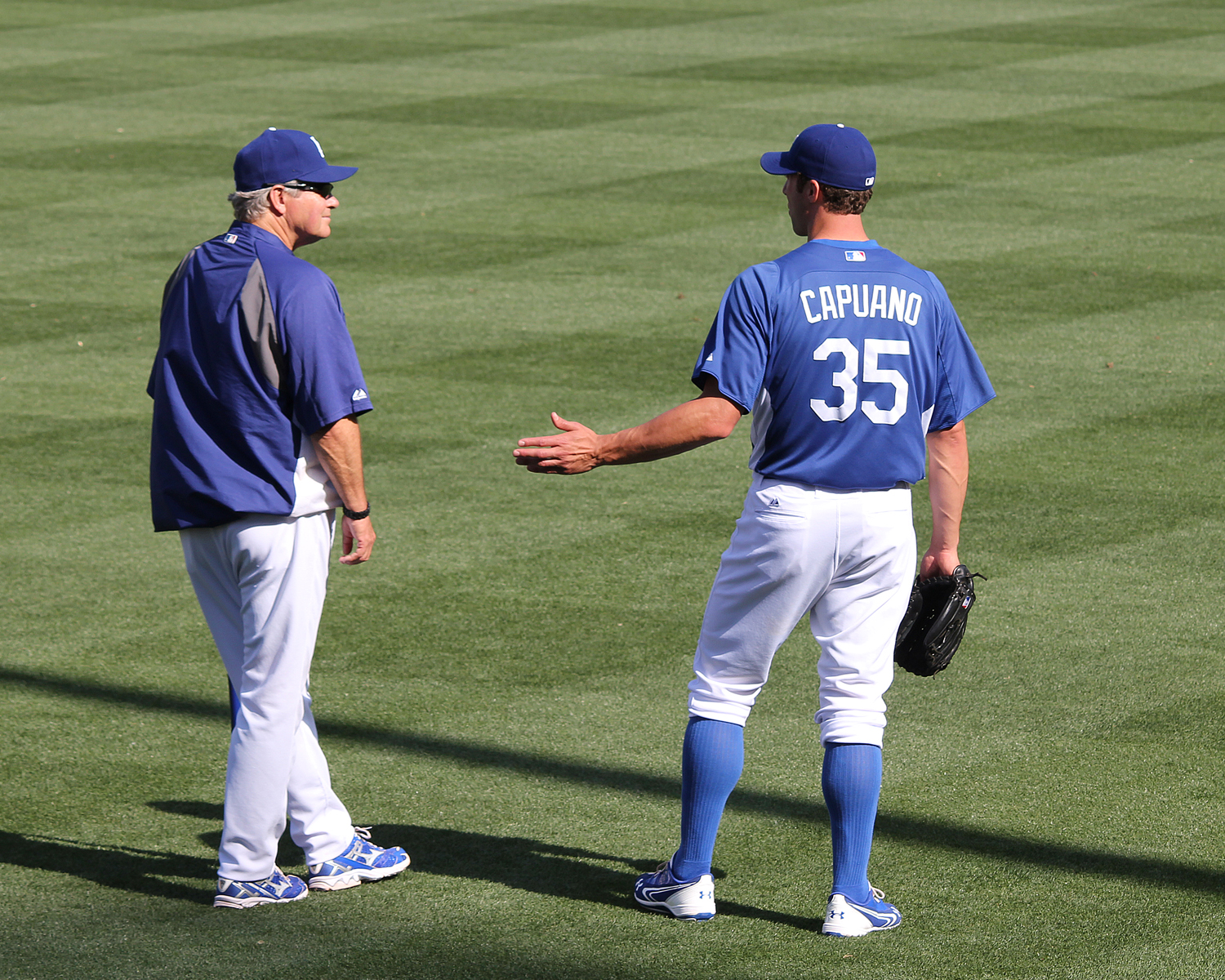
Capuano: EephusBlue, Paint the Corners
Billingsley: SD Dirk, Flickr

Thursday, October 18, 2012

2012 Los Angeles Dodgers Season Review: Rotation


Aside from Clayton Kershaw, the Dodgers' rotation -- despite posting decent numbers -- was generally underwhelming in 2012. September was actually the pitching staff's best month, but even if the Dodgers had made the playoffs, they didn't have the starting pitching to hang with the big boys.

Dodgers' rotation by the numbers
56-56 W-L
3.41 ERA
1.25 WHIP
8.2 H/9
0.8 HR/9
3.0 BB/9
7.5 K/9
2.51 K/BB
2 CG, 2 SHO (both by Kershaw)

Rotation

Clayton Kershaw
14-9, 2.53 ERA, 1.02 WHIP, 6.7 H/9, 0.6 HR/9, 2.5 BB/9, 9.1 K/9, 2.89 FIP
- Kershaw wasn't as dominant as he was in 2011, but he wasn't as far off those numbers as some would lead you to believe. Kershaw still led the majors in ERA for a second consecutive season and led the majors in hits per nine innings. He also led the National League in WHIP. His slider wasn't nearly as good a pitch as it was in 2011, but his fastball improved and he made his curveball a great weapon again. In fact, his curveball was nearly twice as good as it's ever been. He was the Dodgers' most consistent performer and should take home team MVP honors (for what it's worth).
Grade: A

Chad Billingsley
10-9, 3.55 ERA, 1.29 WHIP, 8.9 H/9, 0.7 HR/9, 2.7 BB/9, 7.7 K/9, 3.34 FIP
- Billingsley had just hit his stride before injuring his elbow in late August. It was the second time he hurt his elbow. This time, it might mean Tommy John surgery. He emerged as the Dodgers' second-best pitcher and would have been a big help in September. He had a career-low walks per nine rate and a career-best strikeout-to-walk ratio. Let's just hope his elbow recovers well enough for him to pitch in 2013. I'd be surprised if it does, though.
Grade: B

Chris Capuano
12-12, 3.72 ERA, 1.22 WHIP, 8.5 H/9, 1.1 HR/9, 2.5 BB/9, 7.4 K/9, 3.95 FIP
- Capuano was brought in to help alleviate the loss of Hiroki Kuroda, and he did an admirable job doing so. He scored career-bests in ERA, WHIP and hits per nine innings. He pitched so well that he garnered some All-Star consideration from some. I wasn't appalled by his signing, but I was still wanting Kuroda to return. He was consistent in the first half before seemingly running out of gas in the second half.
Grade: B-

Aaron Harang
10-10, 3.72 ERA, 1.40 WHIP, 8.7 H/9, 0.7 HR/9, 4.3 BB/9, 6.6 K/9, 4.14 FIP
- Harang, all things being equal, was reasonably adequate for the Dodgers this season. We all remember his Dodger record nine consecutive strikeouts, but that's about all we remember. Harang's walks per nine innings and walk-to-strikeout ratio were not in line with his career numbers, accounting for a high WHIP. He's a prime candidate to be traded or sent to the bullpen come 2013.
Grade: C

Joe Blanton
2-4, 4.99 ERA, 1.42 WHIP, 10.3 H/9, 1.1 HR/9, 2.5 BB/9, 8.0 K/9, 4.26 FIP
- Blanton came over in an August trade that sent Ryan O'Sullivan to the Phillies. I was actually a fan of this deal when it went down (though, I would have rather kept O'Sulivan), but Blanton struggled in his 10 starts as a Dodger. He's a free agent and I'd be surprised if he was re-signed.
Grade: D

Nathan Eovaldi
1-6, 4.15 ERA, 1.47 WHIP, 10.1 H/9, 0.8 HR/9, 3.2 BB/9, 5.4 K/9, 4.11 FIP
- Eovaldi began the season in Double-A -- just as he did last season -- and was recalled to fill a rotation void. He was decent in his second go-round with the Dodgers before he was traded with Scott McGough for Hanley Ramirez. Eovaldi pitched similarly in Florida, but there's still a lot of promise left in his 22-year-old arm.
Grade: C

Ted Lilly
5-1, 3.14 ERA, 1.13 WHIP, 6.7 H/9, 0.6 HR/9, 3.5 BB/9, 5.7 K/9, 3.92 FIP
- Lilly got off to a fast start before suffering what would end up being a season-ending shoulder injury in May. Before allowing eight earned runs in 3 1/3 innings in his last start of the season, Lilly owned a 1.79 ERA and had clearly established himself as the Dodgers' third starter. He had shoulder surgery and his status for 2013 is unknown.
Grade: B-

Josh Beckett
2-3, 2.93 ERA, 1.33 WHIP, 9.0 H/9, 1.0 HR/9, 2.9 BB/9, 8.0 K/9, 3.61 FIP
- Beckett came over with something to prove. I'm not sure he did, but he pitched reasonably well in his one-plus month with the Dodgers. Beckett is a wild card for the Dodgers. He could be the Dodgers' No. 3 starter Opening Day.
Grade: B

Stephen Fife
0-2, 2.70 ERA, 1.39 WHIP, 8.4 H/9, 0.7 HR/9, 4.1 BB/9, 6.8 K/9, 4.14 FIP
- Fife, a surprise addition to the 40-man roster prior to the season, actually made some meaningful starts for the Dodgers and didn't get shelled. That qualifies as a successful season for the 25-year-old righty. Fife used a lot of smoke and mirrors to get through his starts as he didn't miss many bats.
Grade: C+

Next up: Outfielders

Photo credits
Kershaw: Dustin Nosler, Feelin' Kinda Blue
Eovaldi: EephusBlue, Paint the Corners